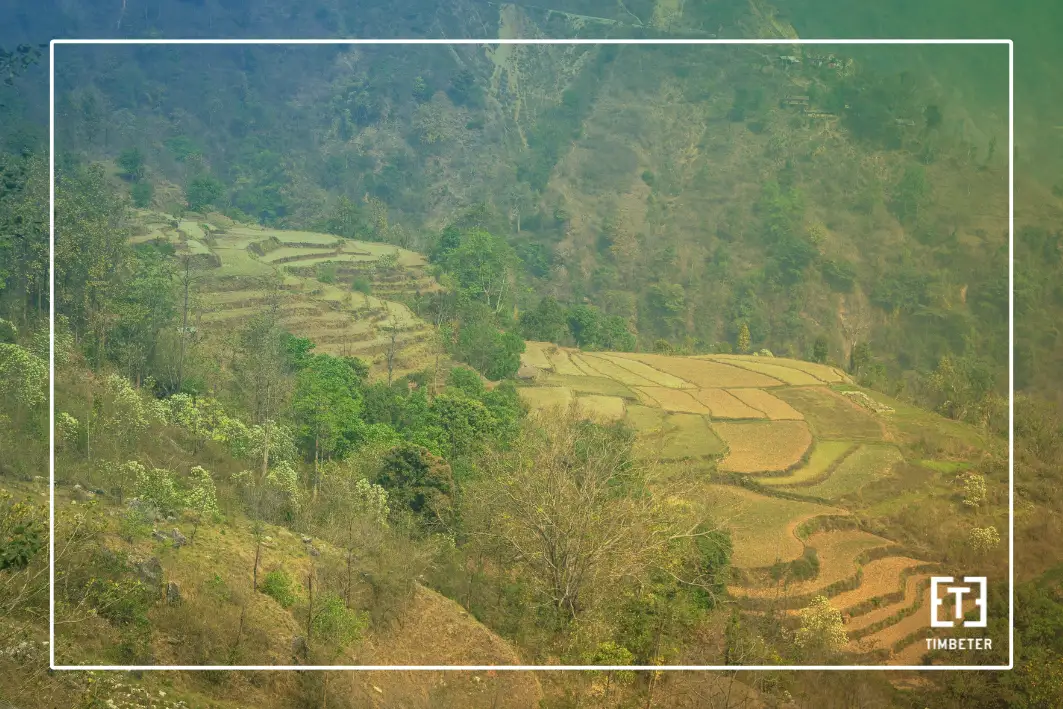
When harvested timber doesn’t turn into revenue
On the roadsides of Nepal’s hills, community forests are stacking timber that isn’t moving. In Dolakha’s Khorthali Community Forest User Group alone, nearly 1,189 cubic meters of timber were harvested in 2025 — roughly the equivalent of 18 standard 40-foot shipping containers — yet around 340 m³ still sits unsold months later. Across other districts, unsold stocks also run into thousands of cubic meters and, in Lumbini province, an estimated 60,000 m³ of timber remains unsold across multiple storage sites and years.
These numbers reflect a familiar forestry challenge: harvesting is completed responsibly, assortments are prepared, piles are stacked — but without clear, standardized inventory data, timber struggles to reach the market.
For community forests, that delay directly impacts reinvestment into silviculture, road maintenance, fire protection, and local development projects. Unsold timber is not just inventory. It is paused forest management.
The operational gap: measurement and market confidence
Community forest operators often rely on manual scaling, handwritten logbooks, and fragmented stock records. Volumes are estimated, sometimes recalculated at the mill, and often debated.
From a buyer’s perspective, uncertainty increases risk. From a community’s perspective, it reduces negotiating power.
What’s missing is not forestry competence. It’s structured, reliable, and shareable timber data.
What changes with digital timber tracking
Digital measurement tools like Timbeter allow operators to measure log piles using a smartphone and generate structured reports within minutes. Instead of approximate roadside volumes, managers can produce documented figures that include gross and net volume, log count, diameter distribution, and assortment breakdown.
That shift from “estimated pile” to “documented inventory” changes conversations with buyers.
In Southeast Asia, Mekong Timber Plantations noted that more accurate timber stock readings improved planning and delivery coordination with mill partners. The operational benefit was clear: better stock visibility reduced uncertainty and improved decision-making in the supply chain.
Similarly, in Thailand, Krit Sanaluck from Siam Forestry described how standardized measurement data strengthened forecasting and improved discussions with mills about diameter classes and grade distribution. Field data translated directly into commercial clarity.
In practical terms, digital measurement reduces disputes at the mill yard, limits re-scaling, and shortens the sales cycle. When buyers can see documented volumes and assortment structures in advance, negotiations become fact-based rather than assumption-based.
Strengthening governance and sustainability
Community forestry depends on trust — within the forest user group and with external stakeholders.
Digitally recorded timber volumes make revenue calculations clearer and reporting more transparent. Harvested volumes can be compared directly with sold volumes, improving accountability and internal governance.
This also strengthens sustainability. Responsible harvesting is only one part of sustainable forestry. Accurate volume accounting ensures that what is cut, transported, and sold aligns with management plans and regulatory requirements.
As buyers increasingly demand traceability and verifiable data, digital measurement supports compliance frameworks more effectively than paper-based systems.
Turning unsold stock into opportunity
The situation in Nepal — thousands of cubic meters harvested but not sold — highlights an operational reality across many regions. Timber may be present, but without trusted measurement and clear inventory visibility, markets hesitate.
Community forests already perform the hard work in the stand: planning, thinning, harvesting, sorting. Digital timber tracking ensures that this work translates into transparent stock data that buyers can rely on.
Better data does not change the forest. It changes the outcome.
If you want to see how digital timber measurement can help reduce unsold stocks, improve buyer confidence, and strengthen governance in your forestry operations, talk to our team or try measuring with Timbeter on your next pile.
Source: https://news.mongabay.com/2026/02/nepals-community-forests-sit-on-unsold-timber/
Turn stacked timber into documented inventory buyers trust.
When timber sits unsold, it's often a data problem — not a supply problem. Timbeter gives your field teams a fast, smartphone-based way to produce verified volume reports that move negotiations forward.
Book a Free Demo