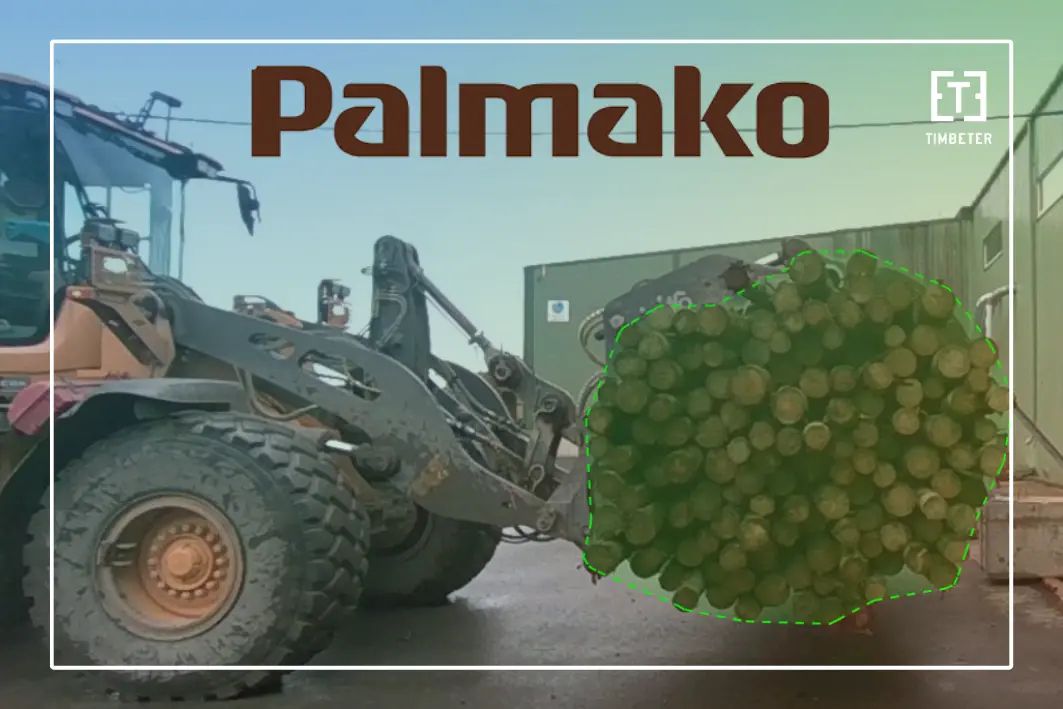
A forklift pulls up to the sawmill yard. The machine operator, mid-run at the cutting line, has to stop, walk outside, take the measurements by hand, scribble them on paper, and walk back in. It sounds like a minor interruption — but multiply it across every timber delivery across a full production shift, and it becomes a genuine operational drag: lost machine time, handwriting errors, and a workplace risk every time someone steps outside in icy Estonian winter conditions.
This was the daily reality at Palmako’s Ojaküla production facility before they deployed Timbeter’s stationary measurement solution. Palmako is one of Estonia’s leading producers of wooden garden houses, glulam, round-profiled, and pressure-treated timber. Founded in 1997 in Tartu, the company now operates subsidiaries in five countries. Precision in raw material intake is not a minor detail for an operation at that scale — it is the foundation of production planning.
Manual measurement was the bottleneck, not the measurement itself
The core problem was not inaccuracy. It was process interruption. Every time a forklift arrived with a timber load, the machine operator had to leave the line, go outside to take measurements, record the figures on paper, and return. According to Aivar Kaldaru, Production Manager at Palmako’s Ojaküla plant, this divided attention and caused production disruptions. The measurement task was pulling the wrong person away from the wrong job at the wrong moment.
This is a pattern common to high-volume timber processing facilities. When measurement responsibility sits with someone whose primary job is elsewhere — whether that is a machine operator, a line supervisor, or a yard manager — measurement either delays production or gets done hastily. Neither outcome is good for data quality or throughput.
A stationary solution built for continuous intake operations
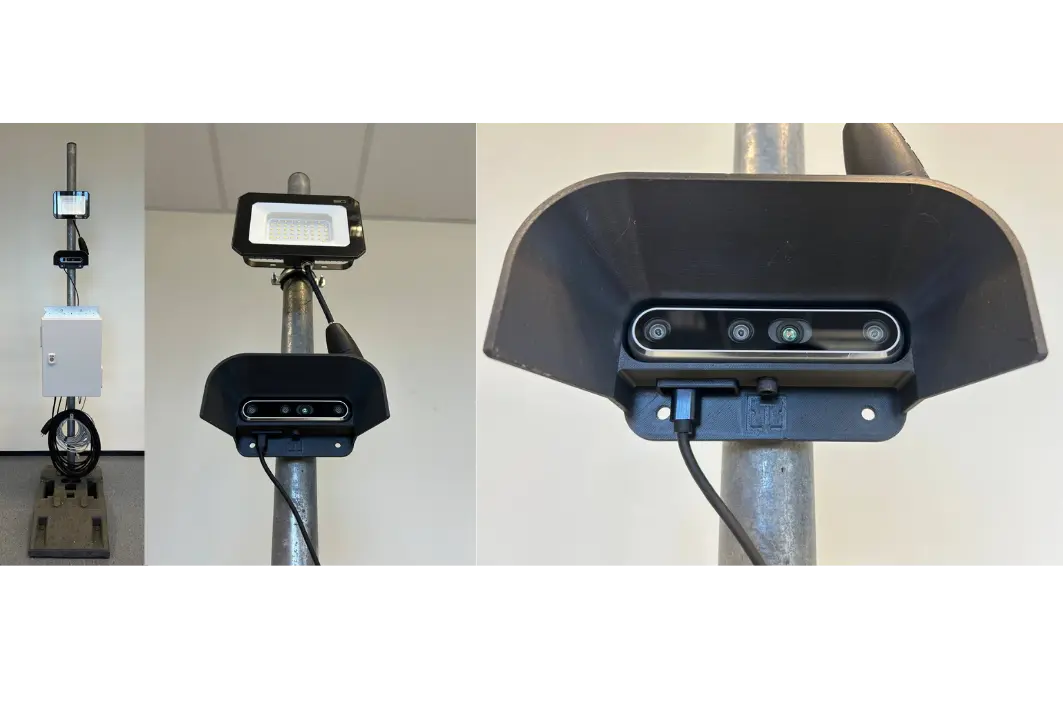
Timbeter’s stationary measurement solution addresses exactly this kind of facility-level challenge. Unlike mobile measurement — where the operator carries the device to the log pile — the stationary setup positions the measurement point at a fixed location in the yard. The forklift driver pulls the load to a designated spot, takes a photo, and the measurement data is captured and stored automatically. No paper. No manual entry. No line stoppage.
At Ojaküla, the workflow shift was direct. The forklift driver now handles measurement as part of the delivery sequence — drive to the designated position, photograph the load, done. The cutting line operator stays at the machine. The data reaches the office without anyone transcribing a single figure. “Now the forklift driver measures themselves,” said Kaldaru. “The operator no longer needs to deal with measurement at all, and as a result, machine efficiency has increased noticeably.”
The stationary system has been running at Ojaküla for over a year. Manual data entry into office systems has been eliminated entirely. The process is fully automatic and paperless — a practical outcome, not a theoretical one.
The safety dimension that often goes unmentioned
Production efficiency figures get attention. Safety improvements tend not to make it into operational reports, even when they are significant. Kaldaru specifically noted that the working environment became safer after deployment, particularly in winter. This matters more than it might appear.
In Nordic and Baltic climates, timber yard conditions in winter involve slippery surfaces, reduced visibility, and machinery movement in tight spaces. An operator walking outside repeatedly during a shift — each time a forklift arrives — is exposed to that environment multiple times a day. Removing that routine from the operator’s workflow and transferring it to the forklift driver, who is already outdoors and in motion as part of their normal role, reduces exposure without any change to the actual measurement task.
Implementation and ongoing operation
Palmako’s experience with deployment was straightforward. Kaldaru acknowledged a few initial issues that were resolved quickly. Since then, the system has operated without friction. His assessment of the Timbeter team: cooperation has been smooth and there have been no unresolved problems.
This matters for production facilities weighing a technology decision. Integration risk is a real concern for any plant running continuous shifts — downtime for technical issues has a direct cost. An implementation that resolves early teething issues quickly and then runs reliably is exactly what operations managers need.
Stationary measurement as a structural choice for high-volume facilities
Timbeter’s stationary solution fits a specific operational profile: facilities where timber arrives in a continuous or near-continuous flow, where measurement is a recurring bottleneck, and where the cost of interrupting production staff is high. Sawmills, panel board plants, pellet producers, and large pallet manufacturers operating at volume all fit that profile.
The broader shift underway across timber processing — from manual, paper-based intake to automated, cloud-connected data capture — is being driven by exactly the kind of operational pressure Palmako faced. Facilities that automate measurement at the intake point gain not just data quality, but process continuity. Every load arriving at the gate becomes a clean, timestamped, geotagged data record that flows directly into production planning and inventory management without human intervention.
As traceability requirements in European wood products markets increase — driven by procurement standards, certification schemes, and EU timber regulations — the ability to produce an auditable record of every incoming load becomes operationally necessary, not just useful. Stationary measurement handles that automatically.
When the right measurement happens at the right point in the process — and the operator stays at the machine — the whole facility runs better. If your intake process still depends on someone leaving their post every time a load arrives, that is the problem worth solving first. Book a demo to see how Timbeter’s stationary solution works in a production environment like yours.
Your intake line shouldn't stop every time a load arrives.
Timbeter's stationary measurement solution puts measurement in the hands of the forklift driver — keeping your operators on the machine and your data flowing automatically to the cloud.
Book a Free Demo