
Timbeter’s EUDR module already submits declarations to TRACES directly. See what it does today, what comes next, and how to join as a pilot before December 2026.
EU deforestation regulation deadline leaves no room to wait
From 30 December 2026, operators placing timber and timber derived products on the EU market must prove, with evidence, that those products are deforestation free and legally produced. That means geolocation data for every plot of origin, production records, a risk assessment, and a Due Diligence Statement or a Simplified Declaration submitted through TRACES before the goods can move. Fines for noncompliance start at 4 percent of a company’s annual turnover.
The rules were simplified at the end of 2025, easing the burden for downstream and smaller operators, and 30 December 2026 now firmly holds as the date, with no sign of a further delay.
For companies sourcing from multiple suppliers across several countries, much of this data still arrives as scanned PDFs, spreadsheets, and email attachments. Collecting it manually, checking it, and then re entering it into TRACES takes real time, and a missing polygon or an unverified reference number can stop a shipment at the border.
A working prototype already submits to TRACES
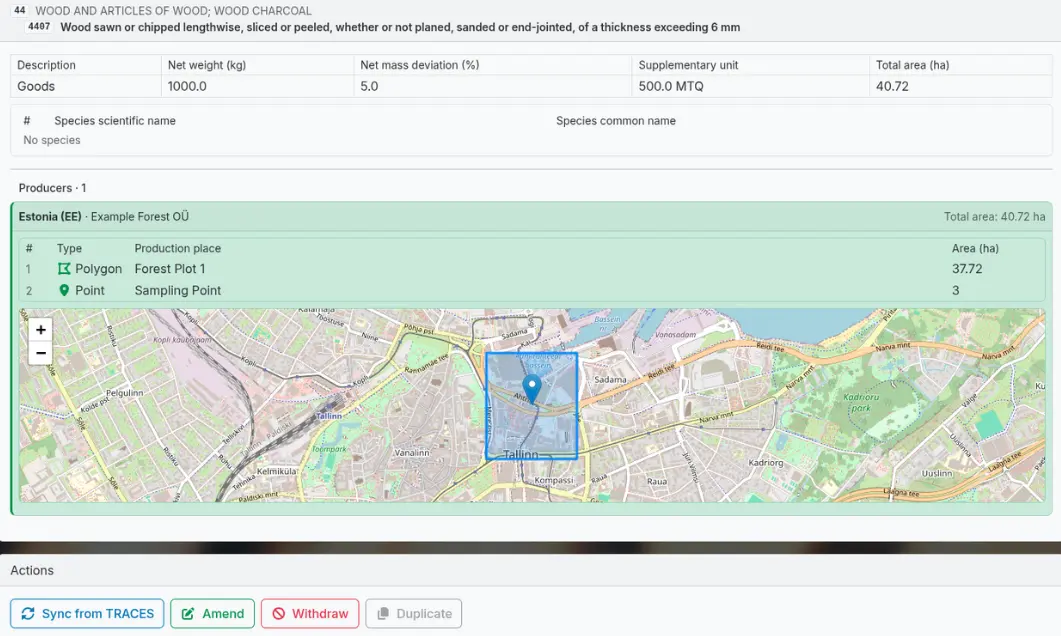
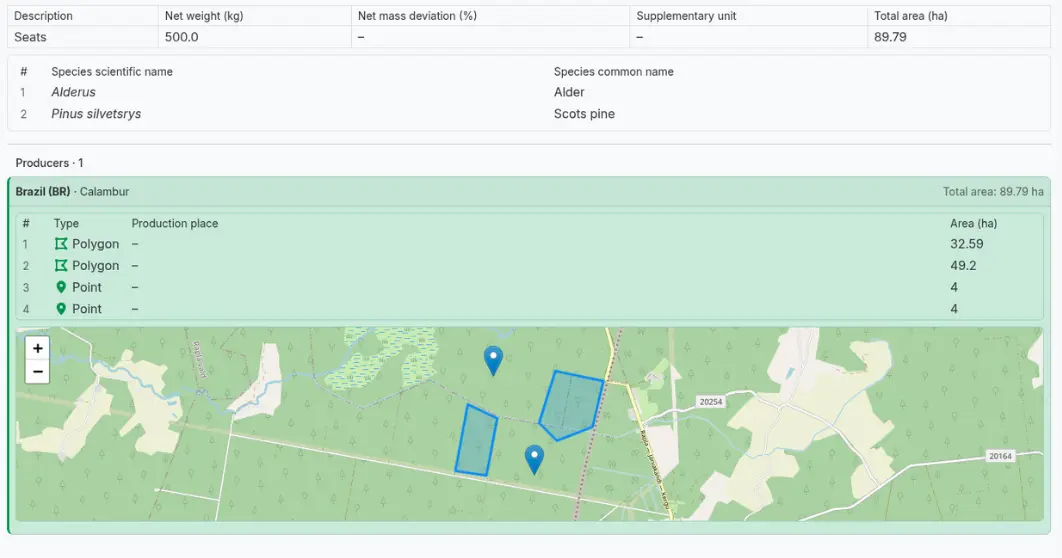
Operators, micro and small primary producers (MSPOs), and downstream operators who are directly liable under EUDR can bring in geolocation by uploading a GeoJSON file, drawing the plot directly, or pulling it from a local land registry such as Metsaregister in Estonia. From there, the module prefills the Due Diligence Statement, submits it directly to TRACES with no separate login required, and stores the resulting reference numbers automatically for five years, with optional validity checks.
Alongside this, Timbeter is developing a separate flow for non EU producers, companies that supply EU buyers but are not themselves liable under EUDR. The goal is a simple way for a supplier outside the EU to package and hand over the compliance data its EU customer needs, without either side relying on email threads and spreadsheets.
More capabilities are planned ahead
Three additions are already on the roadmap. Deforestation free screening against global risk maps is coming, aimed mainly at import flows. A legality document and evidence hub will give operators one place to store supporting paperwork. And the non EU producer side will get a dedicated evidence report, a structured format for suppliers to share their compliance data with EU customers. The exact shape of that supplier facing flow will be defined together with pilot partners, based on how their supply chains actually work.
Supply chain transparency is becoming a market requirement, not just a legal one
EUDR is one part of a broader shift. Buyers across Europe, and increasingly beyond it, are starting to expect traceable, geolocated sourcing data as a normal part of doing business, not an exceptional request. Companies that build this capability now are building infrastructure they will keep using long after the current compliance deadline has passed.
Time is the real constraint here. Development, system integrations, and staff training all take time, and 30 December 2026 is fixed. Timbeter is looking for pilot partners to help finalise this module against real supply chain scenarios. Pilots get a solution tailored to their setup, a discount on the first six months, early access to new features, and a direct line to the product team.
Every week spent on manual TRACES submissions is a week closer to a deadline that will not move. Join as a pilot partner and help shape the flow before it has to work at full scale.
Get your TRACES workflow running well before 30 December 2026.
Join the Timbeter EUDR pilot to shape a module around your real supply chain, with direct TRACES submission, five-year reference storage, and a discount on your first six months.
Book a pilot call